

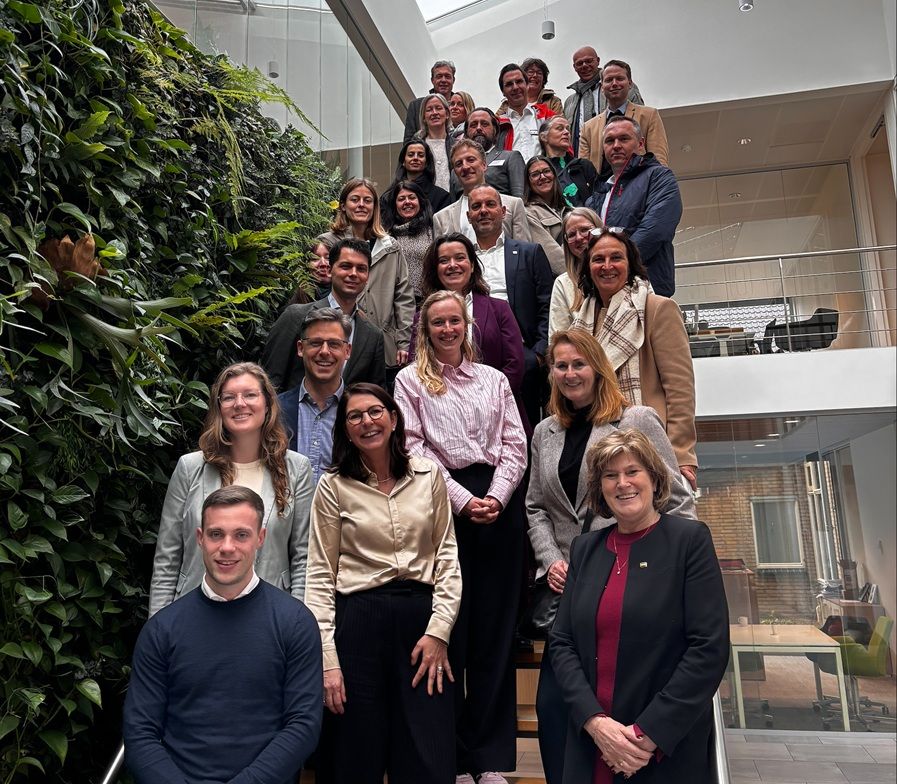
We find it important to organize this exchange right now. Recent reports about an impending total connection stop showed how urgent the situation is in the Netherlands and in our province. There are major shortages on the electricity grid, causing problems for businesses, housing construction, and social facilities. At the same time, in April 2025, we saw in Spain and Portugal how severe the consequences of a major blackout can be. This underlines that grid congestion is not a local or national problem, but a European issue that requires joint answers and international cooperation.

Not a Local Issue
In Gelderland, we see every day what grid congestion means: more than 2,100 companies waiting for a connection and housing and facilities being delayed. During the meeting, we shared that impact but mainly looked for joint solutions. Because this is not a local issue: only in cooperation with our European partners can we make our energy system future-proof.
Deputy for Energy & Climate
Broad Attention to Practice During Work Visits
An important part of the meeting was the work visits. During these visits, we gave the European delegations a concrete and realistic picture of the challenges and innovations in our region.
On the first day, we visited the Cleantech Park in Arnhem. At Connectr, the National Expertise Center Grid Congestion, and innovative companies such as Powercrumbs, Quinteq Energy, and Elestor, examples were shared of battery storage, smart grid solutions, and energy flexibility. During the tour of the HAN Innovation Lab, ElaadNL, and the demo field, our guests saw how Gelderland is working on technology to relieve the electricity grid.
On the second day, the impact of grid congestion on housing construction was central. At Linthorst Energy and in the Kerschoten neighborhood in Apeldoorn, we saw how housing corporations are looking for solutions to still build sustainable homes despite limited connection capacity. They are successful: they recently received permits for homes with a heat network that actually relieves the power grid during peak moments. This made clear again that grid congestion affects not only companies but also residents, new construction projects, and public facilities.
Building Solutions Together
During the TAIEX meeting, we emphasized that cooperation is essential. No region solves this problem alone. By sharing knowledge about smart grids, battery storage, permits, and spatial choices, European regions help each other. Together, we take faster steps toward an energy grid ready for the future.
With this two-day event, we have made a valuable contribution to European knowledge exchange on grid congestion. The insights from the meetings and work visits form a strong basis for further cooperation in Europe and for the steps we take in Gelderland.